Elias Auerbach
Hebrew name: Eliahu Auerbach
Elias Auerbach was the brother of Israel Auerbach (the husband of Bertha Datnowsky).
A German physician, Elias Auerbach was also a Bible scholar and historical writer who published books and essays on Jewish culture and history.
He was active in the Zionist movement in Germany, a member of the Jüdische Humanitätsgesellschaft, and of the Bar Kochba Athletic Association. He was the first German Jew to make Aliyah, and he opened the first Jewish hospital in Haifa.
Early life and Education
Elias Auerbach was born on July 28, 1882, the youngest child of Baruch Menachim (Borukh-Mendel) Auerbach, a rabbi in the town forest of Ritschenwalde in the former Prussian province of Posen (Poznan) (today Ryczywól in Poland). He was made familiar with the world of the Bible from his earliest youth and he understood Hebrew before he had fully mastered the German language.
In 1890 his family moved to Berlin (other sources mention that "his older brothers took him to Berlin when he was ten and enrolled him in a Gymnasium"). In Berlin, Elias studied medicine and in 1905 received his PhD., his final thesis being on the "innervation of the cerebral vessels"(*).
Zionist Work
By the age of 12, Elias was already influenced towards Zionism by his brother-in-law Heinrich Loewe's visits to his family home. (Professor Heinrich Loewe was a prominent German Zionist who married Elias' older sister Johanna.)
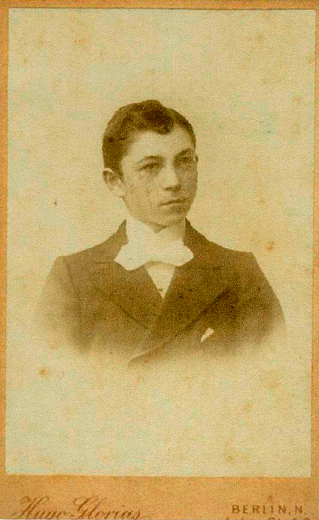
Elias Auerbach, 1896
(Photo courtesy of Jan Price)
As a student he joined the Jewish Students' Union (VJSt, which later became the KJV) founded by his Heinrich Loewe, and decided early on to emigrate to Palestine during his lifetime. An early member of the first circle of young Zionists, he was engaged in the "Academic-Zionist Group" and participated in the Zionist Congresses of 1903, 1905 and 1907.(*). In 1901, Dr. Auerbach was introduced to Herzl in 1901 as an "active Zionist student".
In 1903, while still a student, he participated to the 6th Zionist Congress in Basel. He attended as a journalistic observer, standing directly under the speaker's podium, where he followed the stormy discussions about Herzl's Uganda proposal, which largely dominated the congress. Auerbach joined the opponents of the East Africa project, which rejected Herzl's plans to consider Uganda as a temporary Jewish settlement area into consideration.
Berlin
Elias Auerbach settled down in Berlin-Wilmersdorf as a general practitioner while also working as an assistant to a surgeon at the Physiological Institute of the University of Berlin.
In 1907, Elias Auerbach opened his private clinic in Uhlandstrasse, Berlin.
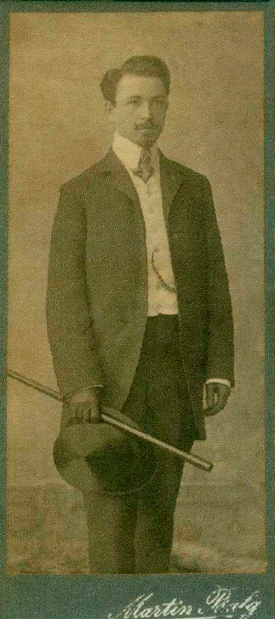
Elias Auerbach, Berlin, 1907
(Photo courtesy of Jan Price)
The same year, during the 8th Zionist Congress in The Hague, he proposed to Rachel Rosenthal, a childhood friend who shared his Zionist beliefs. The couple decided to move to Eretz Israel.
Eretz Israel
In the spring of 1909, Elias Auerbach went on a four-week reconnaissance trip to Palestine. Seeing Haifa, he said "Here I am going to live, work and die!"
Back in Germany, Elias Auerbach and Rachel Rosenthal married in August 1909 and then immigrated to Palestine. The couple settled in Haifa, where Auerbach was the first practicing Jewish physician of the city. The couple had two children, Zeruja and Daniel.
Elias claimed to have been the first German Zionist to settle in the land of Israel for reasons of personal motivation - two men had gone to Palestine because of their work in administrative posts, one for the World Zionist Organization, and the other for the Jewish Colonization Association. (Zionism in Germany 1897-1933, Stephen Poppel)
In his autobiography, Auerbach spoke of the difficulties he experienced settling down in the new country. The strange food, exhausting climate, the constant threat of malaria infection and poor hygiene conditions required much effort. He also recounted that he began to practise under conditions which were "barely imaginable", and how he had to educate not only his staff, but also his patients, until they came to accept his "European" methods.
I imagine my grandmother Ronya Datnowsky visited him during her trip to Palestine in 1910.
In 1911 the Auerbach family moved into a new two-story house behind the German settlement, which housed the living quarters next to Haifa's first Jewish hospital. There was room for Auerbach's horse, which he rode every morning to visit patients in the city.
Jewish Hospital
With the active help of the League of Jewish Women in Berlin and Baroness Rothschild, Elias Auerbach was able to open a small hospital in 1911, in which he himself had to do everything, from delivering babies to the most complicated operations.
Zvi Orloff (later Zvi Nishri) wrote in the Jüdische Turnzeitung (the publication of the Bar-Kochba Sports Association in Berlin) in November 1911:
"In Haifa [...], our Dr. Elias Auerbach has built a hospital in which Mrs. Anni Ballo, a former Bar Kochba member from Berlin, acts as a nurse."
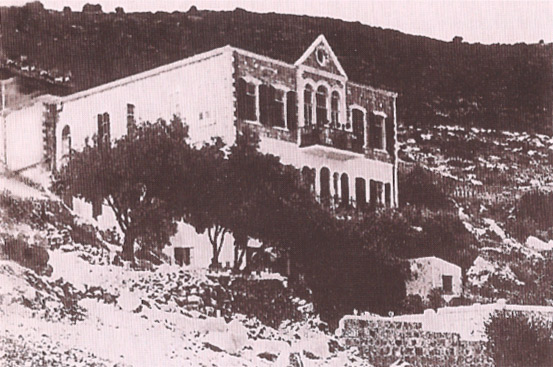
Jewish Hospital, Haifa 1911.
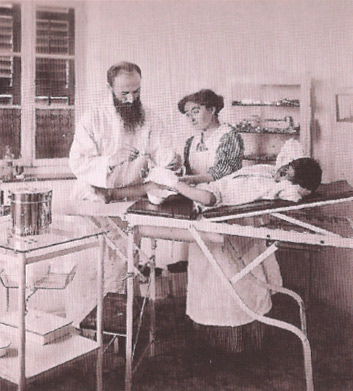
Jewish Hospital, Haifa 1911.
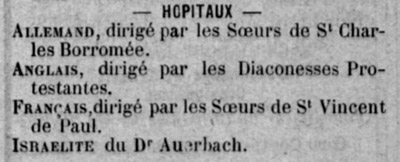
Annuaire Oriental, 1913
The Rothschilds, who visited the country in 1914, supplied Auerbach with the funds to build a large Jewish hospital, a plan which was disrupted by the war. The Rothschild Hospital was not built until much later, at the beginning of the Second World War. (**)
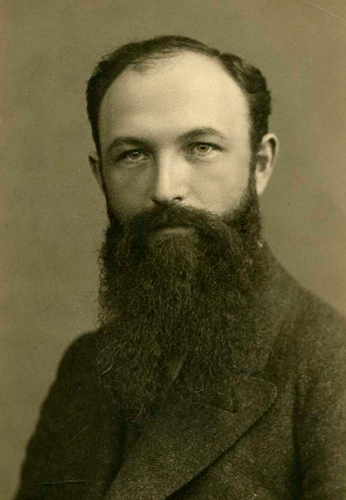
Elias Auebrach, age 29. Haifa, 1912
(Photo courtesy of Jan Price)
Maccabi
In December 1912, Elias Auerbach, along with Herr Neumann*, a teacher of the Agudat Ezra school, founded the sports association "Maccabi Bat Galim", now known as Maccabi Haifa. The club's leading activities were swimming, football and basketball. (Source: Maccabihaifa.co.il) (*Note: another source mentions Elias Auerbach and Ernst Hermann)
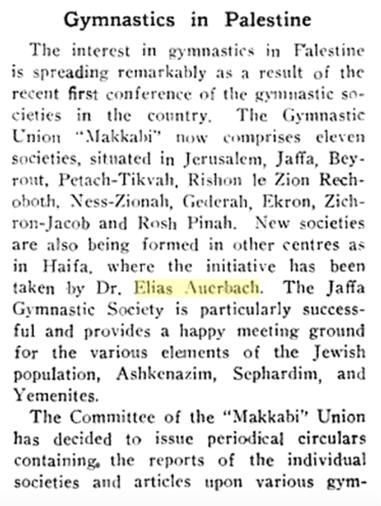
A brief mention of the founding of Haifa's Maccabi appears in "Das Kulturerbe deutschsprachiger Juden: Eine Spurensuche in den Ursprungs-, Transit- und Emigrationsländern" (The cultural heritage of German-speaking Jews: A search for clues in the countries of origin, transit and emigration) (edited by Elke-Vera Kotowski):
"The Maccabi Association in Haifa is [...] an example of the early transfer of the gymnastic and sporting tradition from Germany. Two "Bar Kochbaner" from Berlin, Elias Auerbach and Ernst Hermann, had founded the club in 1912."
Technion
The Hilfsverein der Deutschen Juden (Aid Association of German Jews), which was then beginning to build the Technion, appointed Elias as curator; in this role he had to look after their rights as he was on the spot, and had to deal with the Turkish authorities. Interestingly, Ascher Mallah, (brother-in-law of Elias' brother Israel Auerbach) was instrumental in obtaining the permit from the "Sublime Gate" (The Ottoman government) to establish the Technion.
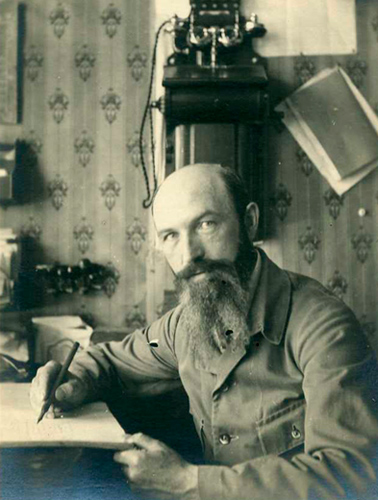
Elias Auebrach
(Photo courtesy of Jan Price)
WW1
Following the outbreak of World War I, Auerbach received his mobilization order to which he had to report within four days at the General Command in Nuremberg. He joined 36 other German conscripts, mostly from the German Colony in Haifa. The newly conscripted men went on a difficult journey first travelling by foot for a few hundred kilometers to Damascus, then crossing Europe by train for ten days. Elias Auerbach would serve as a military doctor for the duration of the war.
According to Amos Elon ("The Pity of it All"), Elias Auerbach had decided to return to Germany to "do his duty" in the German army medical corps at the outbreak of WW1.
He wrote in the Jüdische Rundschau:
"We came back joyfully. It was not only our duty, it was mostly love for the country of our birth."
However, this quote is misleading. According to his grand-nephew Dr. Gilad Rosenberg, this would have been nothing else but a public pronouncement that didn't reflect his actual feelings. According to Auerbach's journal, he didn't enlist but was drafted in the German army, like all German citizens from Palestine - Christian Templers and Jews.
Elias spent most of his active military on western front, serving as a front-line doctor.
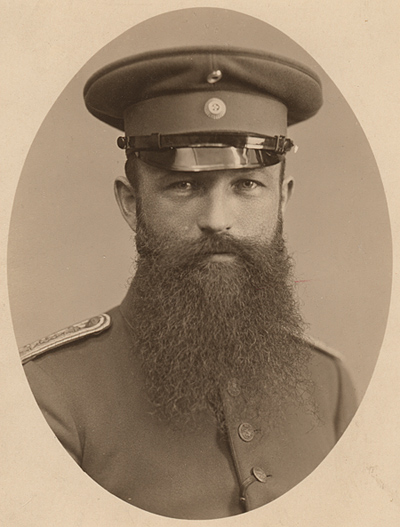
Elias Auerbach, Western Front, 1915
During the First World War, Auerbach learnt Arabic and studied Babylonian and Assyrian cuneiform scripts, laying a foundation for his later historical researches.
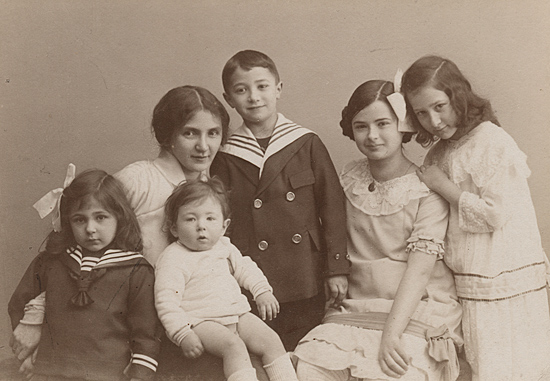
Elias Auerbach's family, Wronke?, 1914 or 1915?.
from Left: Uja (with bow, born 1910), Rachel (Elias's first wife, mother of Uja and Daniel), with Daniel (Dani) on her knees (born 1913), Gideon and Hadassa (children of Johanna and Heinrich Loewe), Lea Auerbach/Rosenberg (Israel and Bertha's daughter) to the right.
After Elias was enlisted and went to Germany to join the army, his wife Rachel couldn't stay on her own with her two young children, so they travelled to join her parents in Wronke (now Wronki in Poland.)
In October 1919, Rachel died in Wronke of the Spanish flu. Elias took his two children to relatives in Berlin. There he married again, to Grete Heilborn.
Elias Auerbach then tried to return with his family to Haifa, but as a German national he was still classified as an enemy of Great Britain, the power controlling Mandate Palestine. He finally received permission for re-entry to Haifa in the summer of 1920 thanks to the mediation of Chaim Weizmann of the Zionist Organisation, and thanks to his Ottoman doctor's licence, which he had obtained in Constantinople in 1909.
In Haifa, Auerbach reopened his practice which he operated until he retired and moved to gynecology and obstetrics. Together with a colleague, he operated a private hospital between the years 1925 to 1930.
Elias had two more children with his new wife Grete, Hanna (November 26, 1920) and Victor (Avigdor) (August 24, 1922).
On February 10, 1923, Elias was one of the speakers at a reception held in Haifa in honor of Einstein during his visit to the Technion.
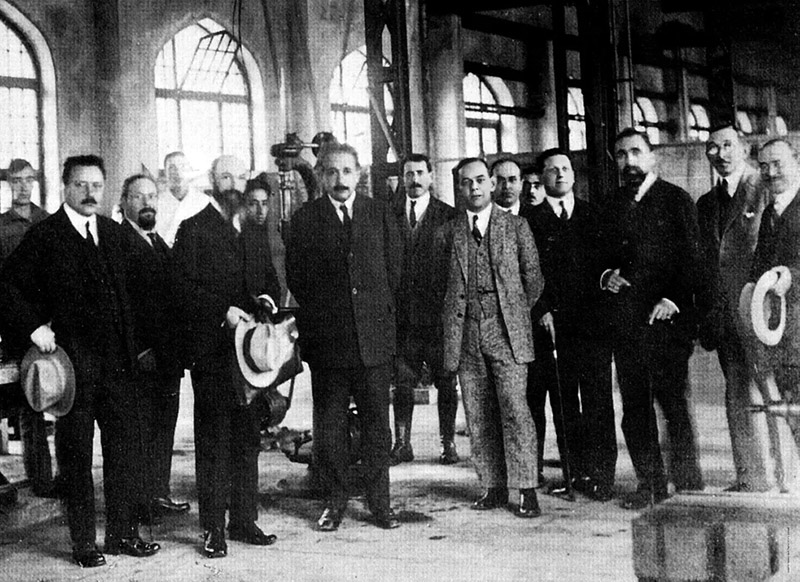
Elias Auerbach (holding a light-colored hat) to Einstein's right. Technion, Haifa, February 10, 1923.
Between 1930 and 1933, the Auerbach family returned to Germany once again, this time due to the illness of Auerbach's second wife Grete. During this time he taught in Berlin Biblical studies at the College of Jewish Studies.
According to her grand-daughter:
Gretchen (as Grete was called by her grandchildren) hated the heat of Palestine and persuaded Elias to keep returning to Berlin. They made many journeys backwards and forwards between Berlin and Haifa before 1933.
Upon his return to Haifa again in 1933, helped many immigrants from Germany to integrate into everyday life. A sparkling orator, he found a renewed interest in politics and in 1942 made a short venture into active politics: he was one of the founding members of the party "Aliyah Chadasha" (New Immigration), a liberal group which tried to represent the interests of "Jeckes" (German immigrants). In the municipal elections in Haifa in 1942 the party won a surprise 22 percent of the votes and thus became the second largest party. Auerbach took over the group's presidency. He left politics after the founding of Israel in 1948.
Works
Dr E. Auerbach was active as a doctor in Haifa for almost 50 years, with several breaks while he concentrated fully on the historical studies for which he became known worldwide. He became a recognised expert on the historical periods he studied, especially the earliest epochs of the Bible.
During his life, Auerbach published numerous books and essays on Jewish culture and history. He is known especially for his contributions to Jewish biblical scholarship. His two-volume magnum opus "Desert and Promised Land" appeared in 1936. (*)
Influenced by the results of the newest critical Bible studies, he became a sharp critic who rejected the traditional ideas of his youth and used new methods to search for knowledge of the Bible. As early as 1920 he had published a book about The Prophets. But his masterpiece is the much admired and much attacked work "Desert and the Promised Land".
Regarding "Desert and Promised Land", Arnold Zweig wrote to Sigmund Freud the following:
Haifa, Mt. Carmel, 1 March 35
Dear Father Freud,
(...) the thought that I might be able to say something to you about your Moses and thus about the cause of your gloom is too strong and my feeling of gratitude to you too pressing to resist. Please read Elias Auerbach's Desert and Promised Land. There you will find in print all the daring statements you touched on in your last letter. Horeb-Sinai etc. He treats only the historical factors but that he does thoroughly and the book is based on a critical and systematic knowledge of the Bible and its sources. There is just one step Auerbach does not take: he does not turn Moscheh into Mizri. It makes extremely stimulating, exciting reading and it is written with exemplary objectivity. So far I have just read the first 100 pages but you would find them of great interest. I am very pleased to be able to draw your attention to this work. Nothing mythological, just an attempt to write history.
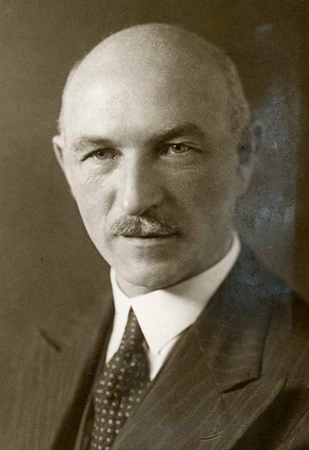
Elias Auebrach
(Photo courtesy of Jan Price)
From 1950 he lectured on biblical subjects and the history of Israel at various European universities.
On the occasion of his 70th birthday, a volume of essays was published in his honor by the Hevrah le-Heker ha-Mikra be-Yisrael, "Sefer Auerbach", ed. by A. Biram (1955).
Auerbach retired in 1959 at the age of 77. In 1960, the city of Haifa made him an honorary citizen.
In 1967, an article celebrating his 85th birthday in D#252;sseldorf's Allgemeine J#252;dische Wochenzeitung mentioned his "youthful vitality and still sharp mind."
According to the same article,
"Despite his traditional education and his earlier traditional lifestyle, he joined the League Against Religious Coercion and took a leading role, even in his capacity as an honorary citizen of Haifa, in protesting against every kind of religious coercion, as he saw it. He was, even in his old age, at heart a young revolutionary, and he rebelled against many a tradition which in his opinion was no longer appropriate to the time."
"Pionier der Verwirklichung" - the first part of his autobiography covering his life up to 1918 - was published in 1969.
Two years later, Elias Auerbach died in 1971 in Israel.
Books by Elias Auerbach
- Joab, ein Heldenleben. Jüdischer Verlag, Berlin. Jewish Youth Books, 1920. (novel)
- Die Prophetie Jüdischer Verlag, Berlin, 1920. (Psychological probe into the nature of prophecy based mainly on the religious experience of Jeremiah.)
- Palaestina Als Judenland-Herausgegeben Vom Aktionskomitee Der Zionistischen Organisation. Kommission beim Juedischen Verlag, Berlin & Leipzig. 1912
- Moses. (A search for the historic Moses.)
-
Wüste und Gelobtes Land.
- Vol 1: Geschichte Israels Von Den Anfängen Bis Zum Tode Salomos. (1932)
- Vol 2: Wuste Und Gelobtes Land: Geschichte Israels Vom Tode Salomos Bis Ezra Und Nehemia. (1936) Berlin: Kurt Wolff Verlag, 1932, 1936. (A history of Israel from its beginning until the period of the return from Babylon.) (Translations: "Desert and Promised Land")("Ha-Midbar ve-Erez ha-Behirah"), 2 vols., 1957-62. -
Autobiography: "Pionier der Verwirklichung. Ein Arzt aus Deutschland erzählt vom Beginn der zionistischen Bewegung."
Deutsche Verlags-Anstalt, 1969.
(Auerbach's autobiography up to 1918.)
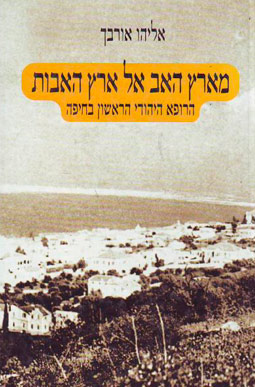
(Hebrew translation: "From The Fatherland to the Land of the Fathers, the first Jewish doctor in Haifa", Hebrew version published in 1997.)
Articles by Elias Auerbach
List of publications:
- Die Welt(1903,1904,1914)
- Ost und West (1904)
- Zeitschrift für Demographie und Statistik der Juden (1907-1909)
- Neue jüdische Monatshefte (1916-1919)
List of articles written by Elias Auerbach: http://www.compactmemory.de.
Click on "Suche" (Search) and enter "Elias Auerbach".
Manuscripts of Elias Auerbach
The University of Heidelberg acquired in 2011 a suitcase of manuscripts - including for his autobiography which contains more info that what made it in the published version. They are held in the Central Archives for research into the history of Jews in Germany
http://www.uni-heidelberg.de/institute/sonst/aj/PERSONEN/AUERBACH/verzeichnis-ab.htm (in German)
- Special Thanks:
- Andrea Livnat, for allowing me to reproduce large excerpts from her article on Elias Auerbach ("Jüdische Ärzte aus Deutschland und ihr Anteil am Aufbau des israelischen Gesundheitswesens").
- Jan Price (Elias Auerbach's granddaughter) for giving me much of the information, photos and the two articles on Elias Auerbach that are the basis for this page.
- Dr. Gilad Rosenberg for providing the initial information on Elias Auerbach
- Sources and References:
- University of Heidelberg Bio University of Heidleberg
- Article celebrating Elias' 80th birthday: Chadasot, 1962 (pdf). Chadasot, July 27, 1962. Translated from German.
- Article celebrating Elias' 85th birthday: Allgemeine Jüdische Wochenzeitung, 1967 (pdf). Allgemeine Jüdische Wochenzeitung, Düsseldorf, August 4, 1967. Translated from German.
- Zionism in Germany 1897-1933. The Jewish Publication Society of America, 1977
- The Pity of it All.